
EMDR Therapy for Trauma
Do you keep circling back to something that happened, even though part of you knows it’s over? It might show up as nightmares, or as flashbacks that arrive without warning. It might be a temper that flares faster than you’d like. For some people it’s a watchfulness that never quite switches off, a sense of always needing to be ready for whatever might come next. These can be signs that something difficult hasn’t been fully processed, and that your mind and body are still carrying it in the present.
Trauma can come from a single event you can point to, such as a car accident, an assault or sexual violence, a frightening medical procedure or a natural disaster. It can also build up slowly over years, through childhood experiences, abuse, relationships that never felt safe, or grief that never had space to move. Sometimes it happened directly to you. Other times it’s something you witnessed, or something you learned about that struck close to home. Or it can also come from years of hiding parts of yourself or living with rejection.
EMDR therapy is one of the most effective ways of working with this kind of experience. Used within a trauma-informed, body-based approach, it helps your mind and body finish processing what got stuck, so that the past can start to feel like the past.

Why traumatic memories get stuck
Most difficult memories settle over time. Your mind gradually links them to what you already know about yourself and the world, and their intensity fades on its own. When an experience is too much to take in, though, that natural processing can stall. What often makes the difference isn’t only the event itself, but whether you had support around you at the time, or felt that you did. Trauma tends to form when we’re left alone with something too big to hold.
When that happens, the memory stays lodged much as it was on the day. It remains vivid and present-tense, cut off from the rest of your story, and something in the present can set it off before you even realise what’s happening. That’s what gives it the power to take over your mood, your body and your reactions, long after the danger has passed.
Signs of unprocessed trauma and PTSD
To protect you from going through that feeling again, your mind and body build defences. At the time they made sense, and they were often the best option you had. Over the years, though, they can narrow the way you live, so that you avoid certain people and places, or keep others at enough of a distance that nobody gets too close. The protection that once helped can quietly outlive its purpose without you noticing.
You might notice:
- Intrusive images or flashbacks
- Nightmares
- Feeling constantly on edge, or easily startled
- Avoiding people, places or situations that remind you of what happened
- Anger that surfaces faster than it used to
- Feeling flat, numb or disconnected from people around you
If these have lasted more than a month, they may meet the criteria for post-traumatic stress disorder (PTSD). PTSD tends to spill into other areas of life too: sleep, concentration, relationships and how safe you feel in your own body.
Anxiety, low mood and shame after trauma
Trauma rarely arrives on its own. Anxiety and hypervigilance (being in a heightened state of alert) are your nervous system doing what it learned to do to keep you safe, and low mood can follow when holding that state for so long becomes exhausting. Shame is common too, especially when you feel you should have prevented what happened, or when it brings up a version of yourself you’d rather forget. Shame grows in isolation, and it often eases once you no longer have to carry the experience alone. None of this needs treating as a separate problem, as it tends to soften as the underlying memory is processed.
How EMDR therapy works
EMDR (Eye Movement Desensitisation and Reprocessing) is a structured way of helping your brain finish processing a memory that got stuck. While you bring the memory to mind in a contained and paced way, I guide you through bilateral stimulation, such as eye movements or alternating taps. This appears to engage a kind of processing similar to what happens naturally during REM sleep as we’re dreaming, so the memory can be filed away as something that happened rather than something that’s still happening.

Working with the body, not just the story
The mind is very good at protecting us, but it can also keep us going round in circles, thinking and rethinking something without ever feeling any different. The body holds its own kind of memory, and it often knows things the mind hasn’t put into words. EMDR works with how experience is held in the body, not only with how it’s remembered or narrated, and that’s part of why it can reach places that talking alone sometimes can’t. It can bring up sensations, images or connections you weren’t consciously aware of, things you didn’t have words for or hadn’t linked together before.
Not everything that surfaces this way is trauma in the strict sense. Sometimes it’s a long-held pattern, a physical tension, or an unease that’s been there so long it feels like part of who you are rather than something that happened to you. Working with this kind of material can be genuinely useful too, even without a single event behind it.
You don’t need to describe the event in detail for EMDR to work, which is one reason people often find it more bearable than they expected. The memory doesn’t disappear and you’ll still remember it, but it stops carrying the same charge. EMDR is recognised by the World Health Organization as an effective treatment for PTSD and is one of the most researched trauma therapies available.
I use EMDR within a broader frame of therapy rather than as a stand-alone technique. The reprocessing sits alongside making sense of what happened and how it fits into your life now, and alongside other somatic and mindfulness-based work when that helps you feel more grounded.

Working with the body, not just the story.
A trauma-informed way of working
Healing trauma isn’t about breaking through your defences. When they’re pushed, they usually hold on even tighter, and for good reason, since keeping you safe is what they were built to do. So rather than forcing anything open, much of the early work is about building enough safety, between us and within your own body, for your guard to lower in its own time. From there it becomes possible to step out of the restricted way of living that trauma creates and start seeing other options. In practice, this means staying within what’s often called your window of tolerance, the range in which you can feel what’s happening without becoming overwhelmed or shutting down.
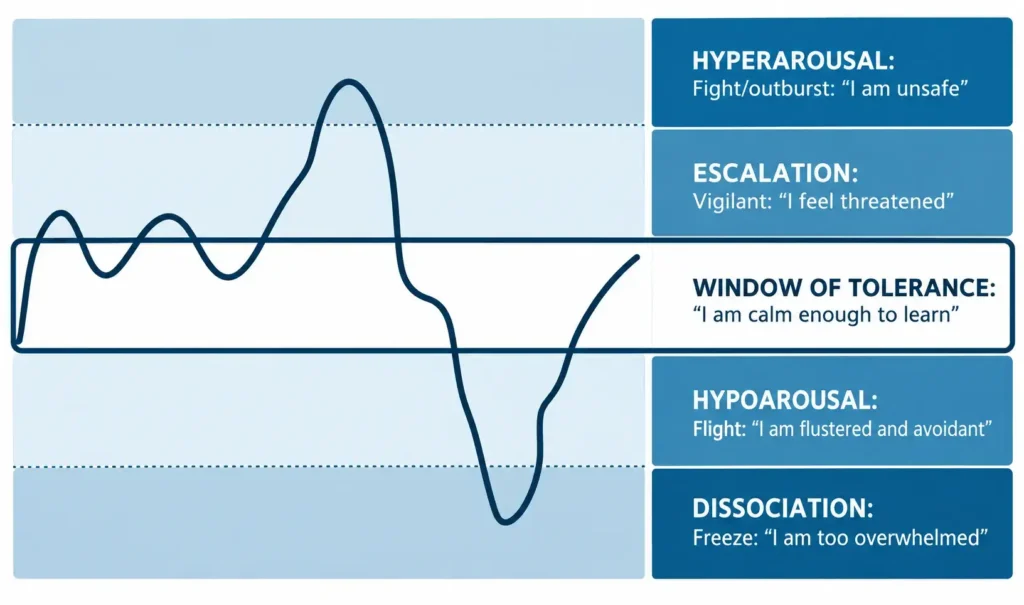
This is slow, deep work, and it can’t be rushed. A plant doesn’t grow faster by being pulled upwards, and doing so only damages its roots. In the same way, we follow the rhythm of your mind and body rather than a timetable. It also means not seeing yourself as the problem. What happened to you happened in a context, often with too little support, and that context deserves as much attention as your own reactions.
Because trauma so often leaves people feeling alone, the relationship between us is a central part of the work. Having someone alongside you who stays with what you bring, without judging it, is often what allows something long held to finally start shifting.

What an EMDR session looks like
EMDR doesn’t start with the memory itself. The first sessions are about understanding what you’re bringing and what has helped you get by until now. We then spend time building ways of steadying yourself, such as grounding in the body or calling to mind a place that feels safe, so you have something to return to if things become intense.
When you feel ready, we choose a memory to work with, and you bring it to mind while following the bilateral stimulation. Between short rounds we pause, and I ask what you’re noticing, which might be an image, a feeling, a thought, a memory or a sensation in your body. We carry on like this until the memory feels less charged. Each session closes with time to settle so you don’t leave feeling stirred up, and the next one begins by looking at what has shifted in the meantime.
Some sessions may run longer than the usual fifty minutes, since this kind of work sometimes needs more time in one go. We’ll agree on what’s needed as we go along, and you’ll find the details on the practical information page.
My experience with trauma and online EMDR
Following the Grenfell Tower fire in London in 2017, I worked as Senior Counsellor and Deputy Head of Service in the London Fire Brigade’s Counselling & Trauma Service. That work meant treating trauma directly, and building trauma-prevention training for firefighters and control staff on the front line of the response.
I now work as an EMDR therapist online with people from many different backgrounds, including single-incident trauma, complex and childhood trauma, and trauma connected to identity, relationships or community. As a queer gay man, I know from my own life how being different from the majority can leave its own marks, so if your experience is tied to sexuality or gender, you won’t need to explain it from scratch. Having lived in several countries, I also know how far away support can feel when something difficult happens while you’re living abroad.
I bring EMDR together with an integrative, mind-body approach, so the work looks not only at the memory itself but at how it has shaped your nervous system, your sense of self and your relationships since. You can read more about my background and qualifications.
If you’re looking for trauma therapy online or an online EMDR therapist, get in touch for a free introductory call. We’ll talk through what’s brought you here and whether this way of working feels like a good fit for you, with no obligation either way.
If you’re a therapist yourself, I also offer supervision for practitioners working with trauma, including EMDR.